Baofeng UV-5R Ham Radio Review
An ultra-affordable dual-band handheld radio that offers remarkable value for emergency communications and preparedness
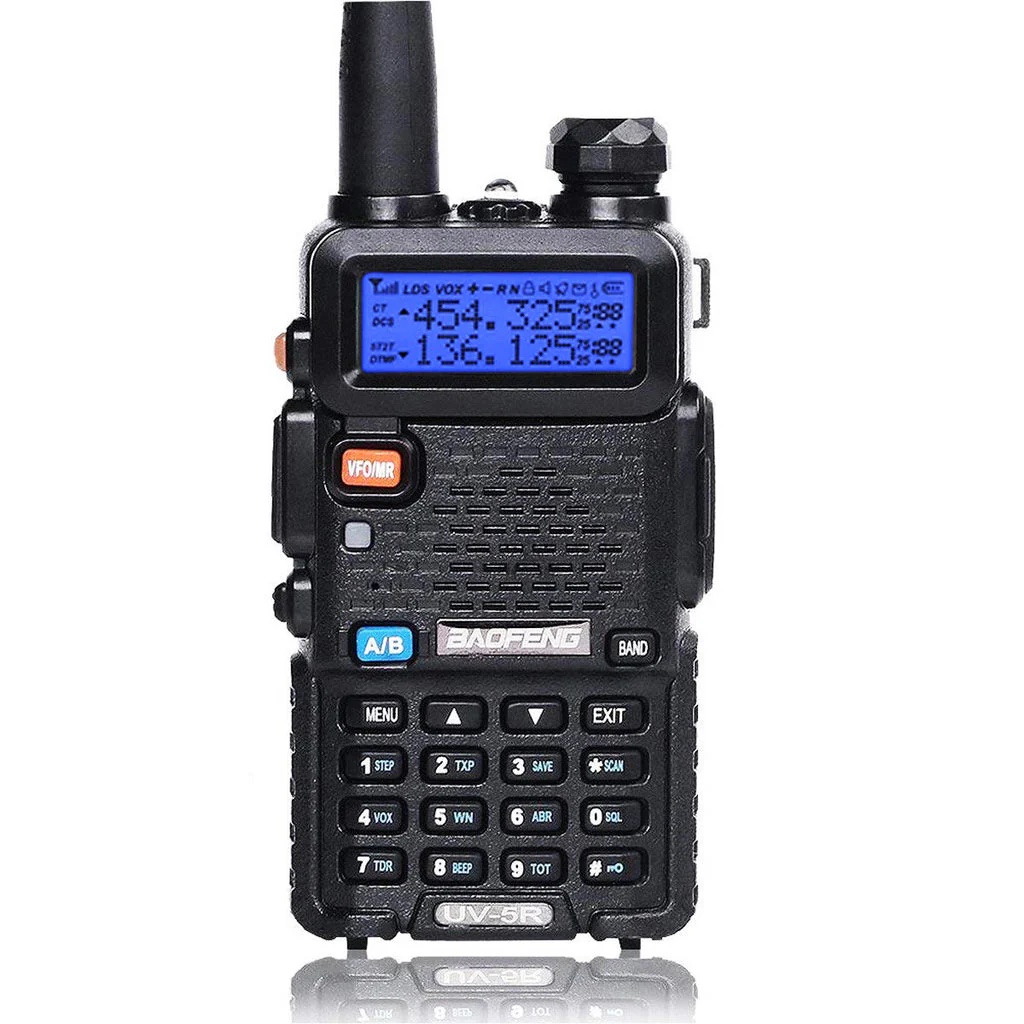
Pros
- Extremely affordable price point ($25-35)
- Dual-band operation (VHF/UHF)
- Decent battery life with upgradable battery options
- Wide frequency range (136-174MHz and 400-520MHz)
- Compact and lightweight design
- Built-in LED flashlight for emergencies
- FM radio receiver for information during emergencies
- Programmable via computer with CHIRP software
- Large ecosystem of accessories and upgrades
- Easily replaceable if lost or damaged
Cons
- Poor quality control between units
- Complicated menu system and programming
- Mediocre stock antenna performance
- Questionable build quality and durability
- Spurious emissions that may violate FCC regulations
- Limited range with stock antenna (typically under 1 mile)
- Not waterproof or particularly rugged
- Requires license for legal transmission on most frequencies
- Audio quality is adequate but not exceptional
- Lacks advanced features of higher-end radios
Specifications
This device requires proper licensing to operate legally on most frequencies. See our review for details.
Our Review
The Baofeng UV-5R has become one of the most popular handheld radios in the preparedness community, largely due to its remarkably low price point and surprisingly capable feature set. After extensive testing and research, we've found that while it has significant limitations, it represents an exceptional value for those seeking an entry-level communications option for emergency preparedness.
First, it's important to address the legal considerations. The Baofeng UV-5R is capable of transmitting on frequencies that require proper licensing in the United States and most other countries. To legally transmit, users need either an Amateur Radio (Ham) license for amateur bands or a GMRS license for those frequencies. The radio can be programmed to operate on FRS frequencies, but its power output exceeds legal limits for those bands, making such use technically illegal except in true emergencies. Always remember that in life-threatening emergencies, you can use any means of communication available regardless of licensing.
The UV-5R is a dual-band radio capable of operating on both VHF (136-174MHz) and UHF (400-520MHz) frequencies. This versatility allows it to communicate on amateur radio bands, GMRS, MURS (with power limitations), and to receive various public service transmissions. The ability to monitor multiple types of communications during an emergency is valuable, even if you're only licensed to transmit on specific frequencies.
In our field testing, the UV-5R demonstrated adequate but not exceptional performance. With the stock rubber duck antenna, communication range was limited to approximately 0.5-1 mile in suburban environments and up to 3 miles with clear line of sight. This is sufficient for neighborhood emergency coordination or family communications during an evacuation but falls far short of what might be needed for more extensive emergency operations. Fortunately, the antenna is easily upgradable, and aftermarket options like the Nagoya NA-771 can significantly improve range and clarity.
The build quality reflects the budget price point. While not flimsy, the UV-5R lacks the ruggedness of professional-grade radios. The plastic housing can withstand normal handling but isn't designed for harsh treatment or adverse weather conditions. There's no waterproofing, so exposure to rain or high humidity environments could damage the unit. For preparedness purposes, we recommend storing it in a waterproof container when not in use and considering protective cases for field deployment.
Battery life is surprisingly good for such an inexpensive radio. The standard 1800mAh battery provides 8-12 hours of typical use (5% transmit, 5% receive, 90% standby). Extended batteries are available, with 3800mAh options nearly doubling the operational time. The ability to keep multiple charged batteries on hand makes the UV-5R viable for extended emergency situations, and the batteries can be charged via various methods including USB adapters compatible with portable solar panels.
Programming the UV-5R is perhaps its most significant challenge. The menu system is not intuitive, and the included manual is often poorly translated and incomplete. While basic frequency input can be done via the keypad, setting up channels with appropriate CTCSS/DCS tones, offsets for repeaters, and custom channel names is cumbersome. We strongly recommend using CHIRP software with a programming cable to configure the radio via computer. This approach is far more efficient and allows you to save configurations for quick reprogramming if needed.
Additional features that enhance the UV-5R's utility for preparedness include a built-in LED flashlight, FM broadcast radio receiver (88-108MHz), and emergency alarm function. The FM radio capability is particularly valuable during disasters when commercial broadcasts may be one of the few sources of information. The flashlight, while not powerful enough to replace a dedicated light, provides useful illumination in a pinch.
One technical concern worth noting is that the UV-5R has been documented to produce spurious emissions outside its intended transmission frequencies. This means it may interfere with other communications services unintentionally. While this is primarily a regulatory concern during normal times, it's worth understanding that the radio's design doesn't meet the strict technical standards of more expensive equipment.
Conclusion
The Baofeng UV-5R represents an exceptional value proposition in emergency communications equipment, offering capabilities that would have cost hundreds of dollars just a decade ago at a price point under $35. While it has clear limitations in build quality, ease of use, and technical performance, its affordability makes it possible to equip an entire family or neighborhood group with basic communications capability for the price of a single professional-grade radio. For preparedness purposes, we recommend the UV-5R as part of a layered communications strategy—perhaps not as your only or primary radio, but as a backup or as part of a distributed network of communication devices. Paired with proper licensing, training, and realistic expectations about its capabilities, the Baofeng UV-5R is a worthwhile addition to any emergency preparedness kit.
Alternatives to Consider
Yaesu FT-60R
Higher quality construction and better performance, though at 5-6 times the price of the UV-5R.
Wouxun KG-UV9D Plus
Better build quality and cleaner transmissions than the UV-5R, while still being relatively affordable.
Midland GXT1000VP4
GMRS radio that doesn't require programming and is legal to use with a GMRS license, though with less frequency flexibility.
Motorola T800
FRS/GMRS radio with Bluetooth connectivity to smartphones for off-grid messaging, though with more limited range.