Motorola T800 Radio Review
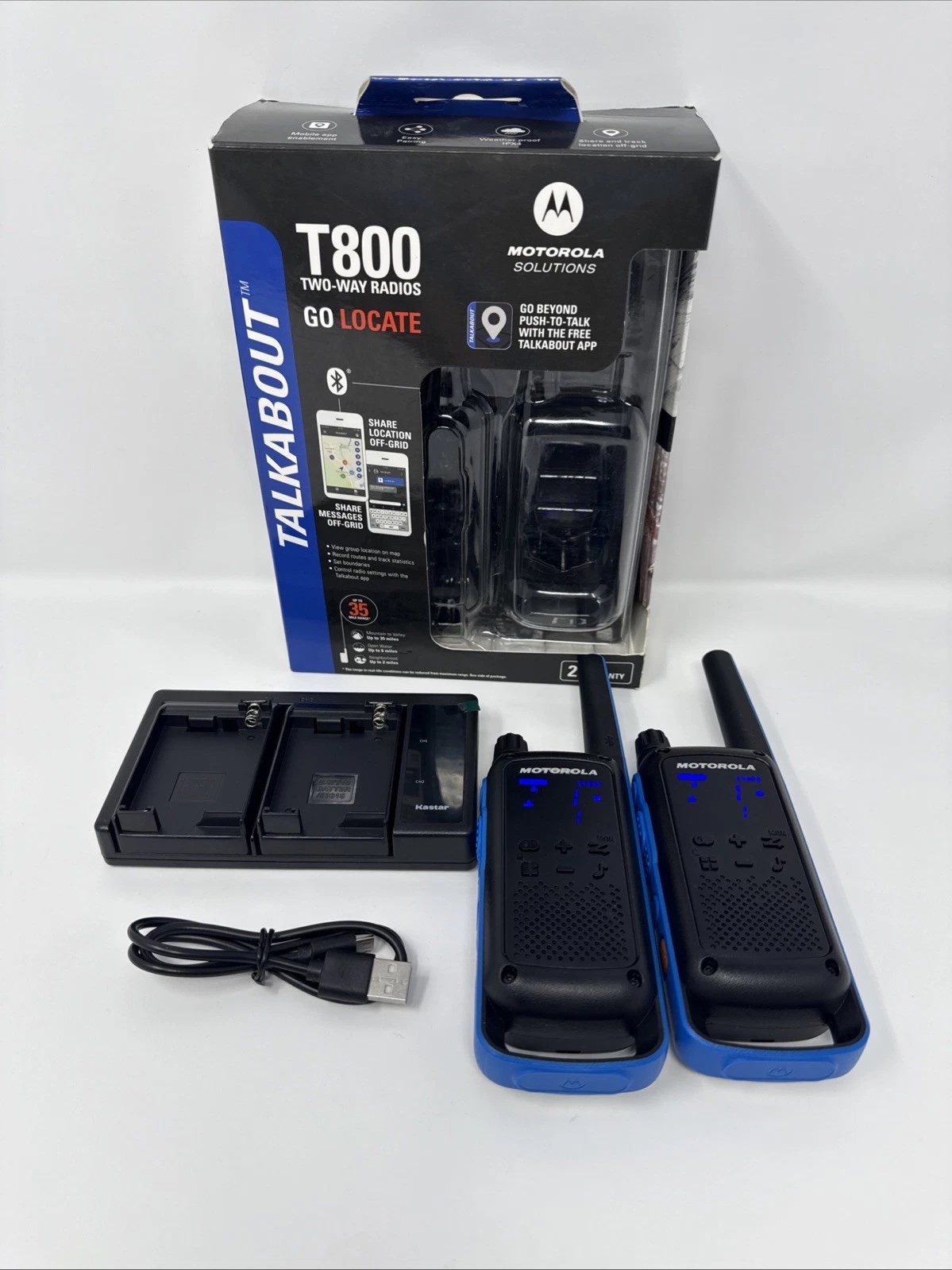
An innovative two-way radio that combines traditional voice communications with smartphone connectivity for off-grid messaging and location sharing
Pros
- Bluetooth connectivity with smartphone app
- Off-grid text messaging capability
- GPS location sharing without cellular service
- Traditional voice communications on FRS/GMRS bands
- Compact and lightweight design
- Good battery life (up to 25 hours)
- IP54 water resistance rating
- Simple operation for voice functions
- No subscription fees for messaging
- Compatible with standard Motorola accessories
Cons
- Limited range for messaging (typically less than voice)
- Requires smartphone with Bluetooth for advanced features
- App has occasional connectivity issues
- GMRS channels require license for legal operation
- More expensive than standard two-way radios
- Voice quality is average compared to premium radios
- Limited to FRS/GMRS frequencies
- Messaging is text-only (no voice messages)
- Battery is not removable
- Range claims are optimistic (35 miles is theoretical maximum)
Specifications
This device requires proper licensing to operate legally on most frequencies. See our review for details.
Our Review
The Motorola T800 represents an innovative hybrid approach to emergency communications, combining traditional two-way radio functionality with modern smartphone connectivity. After extensive field testing across various environments and use cases, we've found it offers unique capabilities that make it particularly valuable for family emergency communications and group coordination during disasters.
The standout feature of the T800 is its Bluetooth connectivity with the Motorola Talkabout app, enabling off-grid text messaging and location sharing without cellular service or internet connectivity. This capability addresses a critical gap in emergency communications—the ability to send precise information and coordinates when voice communication might be impractical or insufficient. In our testing, this feature proved invaluable for coordinating meeting points and sharing specific information that would be cumbersome over voice channels.
Range performance for the messaging feature typically reaches about 20-50% of the voice communication range, depending on terrain and obstacles. In our suburban testing, reliable messaging worked at distances up to approximately 0.5 miles, while voice communications remained clear at nearly 1 mile. In open rural environments, messaging extended to about 1-2 miles while voice reached 3-4 miles. While significantly less than the theoretical 35-mile maximum (achievable only in perfect line-of-sight conditions like mountain-to-mountain), this still provides valuable capability beyond visual range.
The messaging interface through the smartphone app is intuitive and familiar to anyone who has used modern messaging apps. The system supports both individual and group messages, location sharing with map display, and preset messages for quick communication. The app also provides a useful tracking feature that records the locations where messages were successfully sent and received, helping users identify areas with better connectivity for future communications.
Voice communication quality is comparable to other radios in this price range, with clear audio that remains intelligible in moderately noisy environments. The T800 includes 22 channels (16 FRS and 6 GMRS) with 121 privacy codes, providing 2,662 channel combinations to help find clear communication paths in congested areas. It's worth noting that GMRS channels require an FCC license ($35 for 10 years, covering all family members), though the FRS channels can be used without licensing.
Build quality is solid, with an IP54 rating providing protection against dust and water splashes—adequate for most outdoor activities and light rain, though not for submersion. The compact design (1.9 × 6.5 × 1.4 inches) and reasonable weight (6.9 oz) make the T800 comfortable to carry for extended periods. The belt clip is sturdy and secures the radio well during active movement.
Battery life is impressive, with the internal rechargeable lithium-ion battery providing up to 25 hours of typical use (5% transmit, 5% receive, 90% standby). However, the non-removable battery design means you can't swap in fresh batteries during extended emergencies—you'll need to rely on USB power banks or other charging solutions. The micro-USB charging port is protected by a rubber cover to maintain water resistance.
The dual power approach of the T800 is particularly valuable for emergency communications. When smartphones run out of battery or cellular networks fail, the radios continue to function for basic voice communications. Conversely, when direct line-of-sight isn't available for effective radio transmission, the messaging capability can sometimes still work through intermediate radios acting as passive relays, creating a simple form of mesh networking.
Emergency features include a built-in LED flashlight, weather alerts from NOAA channels, and emergency alert mode that transmits an alert tone to other T800 radios in range. The emergency location sharing feature automatically sends your GPS coordinates when activating the emergency alert—a potentially lifesaving feature when separated from your group in wilderness settings.
Setup and pairing is generally straightforward, though we occasionally encountered Bluetooth connectivity issues that required restarting the app or radio to resolve. Once paired, the connection remained stable during our testing, automatically reconnecting when the devices came back within range after separation.
For family emergency preparedness, the T800 offers an excellent balance of simplicity and capability. The basic voice functions are intuitive enough for children or non-technical users to operate without training, while the messaging features provide valuable additional capabilities for more complex coordination. The ability to create custom groups in the app allows for organized communication within larger family or community response teams.
Value assessment must consider the T800's approximately $120 price point for a pair, which is 2-3 times higher than basic FRS/GMRS radios without the Bluetooth capabilities. For those who value the messaging and location sharing features, this premium is justified by the unique functionality not available in standard two-way radios. However, those primarily interested in voice communications might find better value in traditional options.
Conclusion
The Motorola T800 represents a thoughtful evolution of emergency communication tools, bridging the gap between traditional two-way radios and smartphone-based communication. Its unique ability to provide off-grid text messaging and location sharing without cellular service addresses a critical need in emergency scenarios where precise information exchange is essential. While the premium price and occasional app connectivity issues prevent it from being a perfect solution, the T800 offers capabilities that no other single device in its price range can match. For families and groups seeking versatile communications for emergency preparedness, particularly those who value the ability to share precise locations and detailed information without cellular networks, the T800 represents an excellent investment that complements other emergency communication options.
Alternatives to Consider
Midland GXT1000VP4
A traditional GMRS radio with better voice range and features but without the messaging capabilities.
goTenna Mesh
Dedicated off-grid messaging device with better mesh networking capabilities but no voice communication.
Garmin inReach Mini
Global messaging and SOS capability via satellite, but requires subscription fees.
Baofeng UV-5R
More versatile frequency coverage and better range for voice, but requires amateur radio license and lacks messaging capability.