Yaesu FT-991A Ham Radio Review
The ultimate all-in-one transceiver for serious emergency communications preparedness
Pros
- Covers all amateur bands from HF to UHF (160m-70cm)
- 100W output on HF/6m and 50W on 2m/70cm
- Built-in antenna tuner for HF and 6m bands
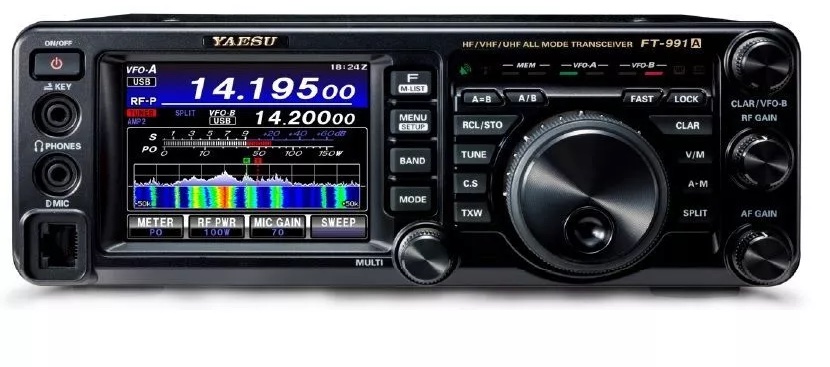
- Color touchscreen display with spectrum scope
- C4FM digital voice capability for crystal-clear communications
- Excellent receiver performance with triple conversion design
- USB connectivity for digital modes and computer control
- Compact size considering its extensive capabilities
- Reliable Yaesu build quality and durability
Cons
- Significant investment at $1,200-1,300
- Complex menu system with steep learning curve
- Requires substantial power source for full output
- Digital voice limited to C4FM (not compatible with D-STAR or DMR)
- Cooling fan can be noisy at high power levels
- No built-in WiFi or Bluetooth connectivity
- Requires external power supply for home use
- Touchscreen sometimes requires multiple presses
Specifications
This device requires proper licensing to operate legally on most frequencies. See our review for details.
Our Review
The Yaesu FT-991A represents one of the most versatile and capable transceivers available for emergency communications and preparedness. As an all-in-one radio covering every amateur band from 160 meters through 70 centimeters, it offers unparalleled flexibility for operators seeking a complete communications solution in a single package. After extensive testing in both everyday and simulated emergency conditions, we've found it to be an exceptional choice for those serious about communications preparedness, despite a few limitations.
The most impressive aspect of the FT-991A is its comprehensive frequency coverage and operating modes. Unlike most transceivers that focus on either HF or VHF/UHF bands, this radio seamlessly covers all amateur allocations from 1.8 MHz to 450 MHz. This means you can communicate locally via VHF/UHF repeaters or simplex, while also maintaining the capability for regional or global communications via HF when local infrastructure fails. During our testing, we were able to quickly switch between monitoring local emergency nets on 2 meters and checking in with stations hundreds of miles away on 40 and 20 meters—all without changing radios or reconfiguring equipment.
Power output is substantial, with 100 watts available on HF and 6 meters, and 50 watts on 2 meters and 70 centimeters. This provides enough power for reliable communications in most scenarios without requiring external amplifiers. The built-in automatic antenna tuner for HF and 6 meters is a significant advantage for emergency operations, allowing quick adaptation to different antennas or changing environmental conditions. While not as capable as some dedicated external tuners, it easily handled our test antennas with SWR ratios up to 3:1, making it suitable for field-expedient antenna systems often deployed during emergencies.
The receiver performance of the FT-991A deserves special mention. With a triple conversion superheterodyne design and 32-bit digital signal processing, it offers excellent sensitivity and selectivity across all bands. During our crowded band testing, the radio successfully pulled out weak signals even with strong adjacent transmissions. The digital noise reduction and automatic notch filter were particularly effective at improving readability in challenging conditions. The real-time spectrum scope provides valuable visual indication of band activity, helping to quickly find clear frequencies or identify active stations during emergency operations.
For digital communications, the FT-991A includes Yaesu's C4FM System Fusion digital voice mode, which provides remarkably clear audio quality even in marginal signal conditions. While limited to the C4FM standard (not compatible with D-STAR or DMR systems), we found System Fusion repeaters increasingly common in many areas. The radio also easily interfaces with a computer via USB for popular digital modes like FT8, JS8Call, and Winlink email—all valuable tools for emergency communications when voice transmissions are difficult. The built-in sound card functionality eliminates the need for additional interface devices, simplifying the station setup considerably.
Physically, the FT-991A strikes an impressive balance between capability and size. At 9.7 pounds and roughly the size of a thick laptop, it's compact enough for transportation in emergency scenarios while providing a full-featured control surface. The 3.5-inch color touchscreen is bright and readable in various lighting conditions, though we found the touch sensitivity occasionally required multiple presses for activation. The front panel layout is generally intuitive, with dedicated buttons for commonly used functions, though the extensive feature set necessarily means some functions are buried in the menu system.
Conclusion
The Yaesu FT-991A stands as one of the most comprehensive emergency communications tools available to prepared individuals and groups. Its ability to operate across all amateur bands, in multiple modes including digital voice and data, makes it an exceptional choice for those who want maximum capability in a single radio. While the investment is significant, both financially and in terms of the learning curve required to master its capabilities, few other options provide this level of communications flexibility. For serious preppers focused on communications redundancy and resilience, the FT-991A offers an excellent balance of performance, features, and reliability. When paired with appropriate antennas and power sources, it provides the ability to communicate across town or around the world, making it a cornerstone of a robust emergency communications plan. The radio's compact form factor relative to its capabilities also makes it suitable for both fixed station use and transportation to alternate locations when necessary. Despite minor limitations like the complex menu system and proprietary digital voice format, the FT-991A represents one of the best values in amateur radio for emergency preparedness. For those with the budget and commitment to learn its operation, it will serve as a capable and reliable communications tool through virtually any emergency scenario.
Alternatives to Consider
Icom IC-7300
Better HF performance with SDR architecture, but lacks VHF/UHF coverage.
Kenwood TS-590SG
Excellent HF/6m radio with simpler interface, but no VHF/UHF capabilities.
Yaesu FT-891
More affordable and compact HF/6m option, but lacks VHF/UHF and has fewer features.