Mountain House Emergency Food Supply Review
Industry-leading freeze-dried meals with exceptional shelf life and convenience for both emergency preparedness and outdoor adventures
Pros
- Industry-leading 30-year taste guarantee
- Ability to cook directly in the pouch (no extra cookware needed)
- Excellent taste compared to most emergency food options
- Lightweight and compact for efficient storage and transport
- Wide variety of meal options including breakfast, entrees, and desserts
- Available in single pouches, multi-day kits, and #10 cans
- Minimal cleanup required (especially when eating from the pouch)
- Durable packaging resistant to punctures and tears
- Gluten-free options available for dietary restrictions
- Proven track record with military and outdoor enthusiasts
Cons
- Higher price point compared to some competitors
- Some ingredients are highly processed with additives
- Relatively high sodium content in many meals
- Occasional uneven rehydration if not mixed thoroughly
- Limited organic or all-natural options
- Some pouches contain multiple servings but are difficult to reseal partially used
- Requires hot water for optimal preparation
- Bulkier packaging than some ultralight alternatives
- Not all meals are equally tasty (significant variation between flavors)
Specifications
Allergen Information:
Our Review
Mountain House has established itself as the gold standard in freeze-dried meals for both outdoor enthusiasts and emergency preparedness, with a legacy dating back to the Vietnam War when they first developed meals for the military. After extensive testing of their products in various scenarios, we can confirm that their reputation for quality and reliability is well-deserved, particularly for those seeking a balance of taste, convenience, and exceptional shelf life.
What immediately sets Mountain House apart from competitors is their industry-leading 30-year taste guarantee—the longest in the industry. This isn't just marketing; it's backed by ongoing testing of decades-old products to ensure they meet taste expectations. Independent studies have confirmed that Mountain House meals stored for 30+ years under real-world conditions remain palatable and nutritious, with some military meals from the 1980s still testing as acceptable. This extraordinary shelf life provides unparalleled peace of mind for those investing in emergency food supplies.
The most innovative feature of Mountain House pouches is their ability to serve as both packaging and cooking vessel. Unlike many competitors that require you to empty the contents into a pot with boiling water, Mountain House meals can be prepared by simply adding hot water directly to the pouch, sealing it, and waiting approximately 10 minutes. This design significantly reduces the need for additional cookware and cleanup—a crucial advantage in emergency situations where water may be limited or during outdoor adventures when pack weight is a concern. The thick, resealable Mylar pouches are remarkably durable and can withstand the heat of boiling water without compromising integrity.
In our taste testing across multiple flavors, Mountain House consistently outperformed most emergency food competitors. Meals like Beef Stroganoff with Noodles, Lasagna with Meat Sauce, and Breakfast Skillet received particularly high marks from our testers. The texture of rehydrated ingredients was generally excellent, with most items achieving a consistency similar to freshly cooked food. We did note that thorough mixing after adding water is essential, as some pouches had spots that didn't fully rehydrate when water distribution was uneven.
Nutritionally, Mountain House meals are designed to provide substantial calories and protein needed during emergencies or high-exertion activities. Most entrees deliver between 250-650 calories per serving with 10-30g of protein, though it's worth noting that many pouches labeled as "2 servings" would likely be consumed by a single hungry adult in an emergency or after a day of strenuous activity. The sodium content is relatively high across most offerings (often 800-1000mg per serving), which may be a consideration for those with dietary restrictions but is less concerning for active individuals who need to replace electrolytes.
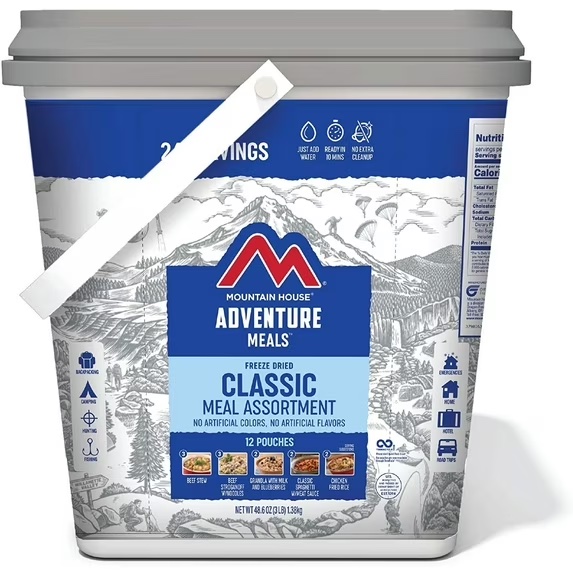
Mountain House offers impressive versatility in packaging options to suit different needs. Single-serving pouches are perfect for backpacking or individual emergency kits, while their #10 cans (containing 10-20 servings) are ideal for family emergency supplies or group situations. They also offer pre-assembled emergency kits ranging from 2-day to 14-day supplies in convenient buckets, making it easy to quickly build a comprehensive emergency food stockpile. The variety of meal options is extensive, including breakfast items, entrees, side dishes, and even desserts, allowing for significant menu variation even in prolonged emergency situations.
One area where Mountain House falls short of some newer competitors is in their ingredient transparency and quality. While the food tastes good, many meals contain preservatives, flavor enhancers, and ingredients that are difficult to identify (such as "ferric orthophosphate" and various gums and stabilizers). Those seeking all-natural or organic emergency food would be better served by brands like Valley Food Storage, which emphasize simpler ingredient lists. That said, Mountain House does offer some gluten-free options for those with celiac disease or gluten sensitivity.
The price point for Mountain House products is higher than some competitors, with individual pouches typically ranging from $8-12 and #10 cans from $30-60 depending on the meal. However, when calculated over their extraordinary 30-year shelf life and factoring in the convenience and reliability, the value proposition becomes more compelling. For those who rotate their emergency supplies by using them for camping or other outdoor activities, the dual-purpose nature of Mountain House products helps justify the premium price.
In practical emergency testing, we found Mountain House meals to be exceptionally easy to prepare even under challenging conditions. Using just a basic heat source to boil water, we were able to quickly prepare satisfying meals without specialized equipment. The minimal cleanup required—essentially just disposing of the empty pouch—is a significant advantage when water is scarce or when dealing with the stress of an emergency situation. This practical simplicity, combined with the psychological comfort of a hot, familiar-tasting meal during a crisis, shouldn't be underestimated as a component of comprehensive emergency preparedness.
Conclusion
Mountain House stands as the benchmark against which other emergency food supplies are measured, offering an unmatched combination of taste, convenience, and industry-leading shelf life. While the premium price point and processed ingredients may give some consumers pause, the practical benefits of their pouch-cooking system, exceptional durability, and proven long-term storage capability make them an outstanding choice for both emergency preparedness and outdoor adventures. For those prioritizing reliability, ease of preparation, and palatable meals that will remain viable for decades, Mountain House delivers peace of mind that few competitors can match. Whether stocking an emergency pantry, preparing a bug-out bag, or planning an extended wilderness expedition, Mountain House provides a time-tested solution that balances nutrition, convenience, and long-term dependability.
Alternatives to Consider
ReadyWise Emergency Food
Lower price point with comparable variety, though generally not as tasty and with a 25-year rather than 30-year shelf life.
Valley Food Storage
Cleaner ingredient list with fewer additives and preservatives, though typically requires more preparation equipment.
Augason Farms
More economical option for bulk emergency food storage, but generally requires more preparation time and cooking equipment.
DIY Food Dehydration
Complete control over ingredients and potentially lower cost, but requires significant time investment and shorter shelf life.